Driving to Saudi Arabia from the UAE: Visa and Border Rules
Yes, a UAE resident expat can drive to Saudi Arabia, but you need a Saudi tourist eVisa approved before you reach the Al Batha border post. Visit Saudi confirms eVisa holders can enter through any formal port of entry. GCC citizens need no visa. Your passport needs six months of validity, your residence permit three, and the car needs a UAE-issued International Driving Permit and a vehicle entry permit.
Yes, a UAE resident expat can drive into Saudi Arabia, but you need a Saudi tourist eVisa in hand before you reach the border. Visit Saudi's help centre confirms that tourists with an eVisa can enter from any formal port of entry, and that includes the land crossing from Abu Dhabi. GCC citizens need no visa at all, and your car needs its own paperwork on top of your visa.
At a glance: driving from the UAE to Saudi Arabia
| Fact | Rule | Source |
|---|---|---|
| Who needs a visa | Expats with a GCC residence permit need a tourist eVisa. GCC nationals travel on their ID or passport with no visa. | Visit Saudi, visa regulations |
| Land entry on an eVisa | Permitted. eVisa holders can come in from any formal port of entry. | Visit Saudi help centre |
| Residence permit validity | At least three months beyond your date of entry into Saudi. | Visit Saudi, visa regulations |
| Passport validity | At least six months beyond your date of entry. | Visit Saudi, visa regulations |
| Visa validity and stay | Multiple entry, valid one year, stay of no more than 90 consecutive days. | Visit Saudi, visa regulations |
| Driving permit | UAE residents driving abroad must apply for an International Driving Permit in the UAE. It is valid for one year. | u.ae, driving abroad |
| Vehicle paperwork | Residents entering by land in their own or rented car need a vehicle entry permit from the competent authority in their country or the authorised agent. | Ministry of Hajj and Umrah FAQ |
What you need before you set off
- Passport valid for at least six months beyond your entry date (Visit Saudi)
- UAE residence permit valid for at least three months beyond your entry date (Visit Saudi)
- Approved Saudi tourist eVisa, printed or saved on your phone
- Emirates ID, since the regulation requires you to hold identification documents at all times (Ministry of Tourism regulation, Article 10)
- International Driving Permit issued in the UAE (u.ae)
- UAE driving licence and the vehicle registration card (Mulkiya)
- Vehicle entry permit from the competent authority or authorised agent (Ministry of Hajj and Umrah)
- Motor insurance that covers you in Saudi Arabia, and valid vehicle insurance for the drive back into the UAE (u.ae)
- A no-objection letter from the finance company if the car is on a bank loan, and from the registered owner if the car is not in your name
Want someone to check your file first?
We review every document against current embassy requirements and flag what causes refusals.
Do UAE residents need a visa to drive into Saudi Arabia?
Yes, unless you hold a GCC passport. Visit Saudi states that GCC nationals do not need a visa and can travel at any time using their ID or passport, so an Emirati, Omani or Kuwaiti citizen simply drives up to the post.
An expat on a UAE residence visa is treated differently. Visit Saudi's help centre confirms that GCC residents are welcome to apply for the tourist visa, which can be issued as an eVisa or through the embassy, and the eVisa is the route that makes sense for a road trip.
The eligibility rules are short. Your GCC residence permit must be valid for at least three months beyond your entry date and your passport for at least six months, and if you are bringing children under 18, a parent has to apply for an eVisa first.
VisaWadi files the Saudi tourist eVisa for GCC residents at AED 700 all inclusive. That price covers the Saudi government fee and the mandatory medical insurance, there is no embassy visit, appointment or biometrics appointment, and the full amount is refunded if the visa is refused, so help with your Saudi Arabia application costs nothing extra if the answer is no.
Not sure which side of the line you fall on? Our post on whether GCC residents need a Saudi visa walks through it nationality by nationality.
Can you enter Saudi Arabia by land on a tourist eVisa?
Yes. The Visit Saudi help centre answers this question directly: tourists with an eVisa can come in from any formal port of entry, and elsewhere on the same page it states that visa holders can enter Saudi through land, sea and air ports.
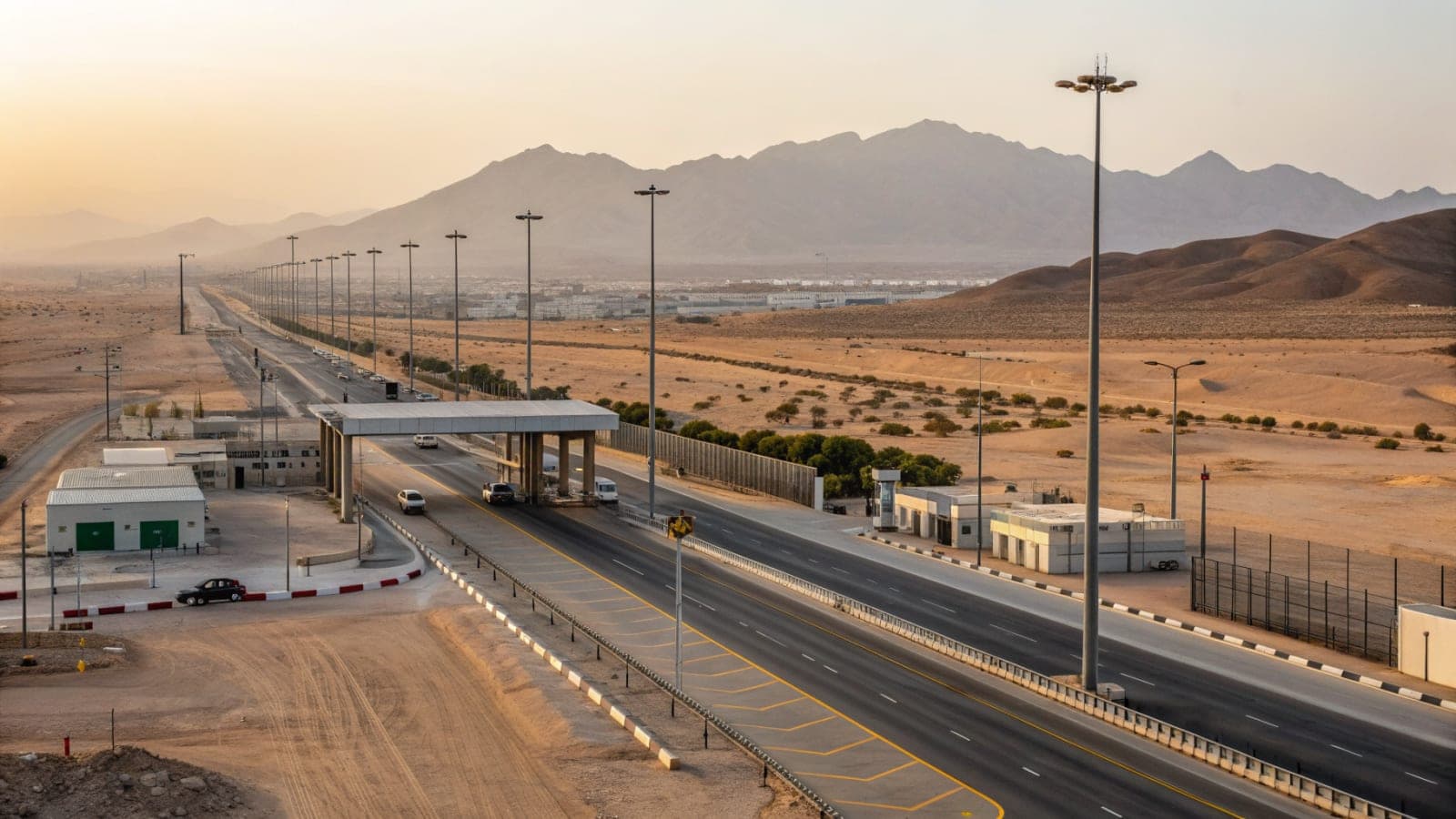
The road from the UAE runs west out of Abu Dhabi. The UAE Government portal explains that the UAE's roads connect to Saudi Arabia and Oman, that you can travel by private car or by government-operated buses, and that some crossing points are exclusive to GCC citizens. On the Saudi side, the crossing is Al Batha, where the General Directorate of Passports runs a branch that processes arrivals from the UAE.
The point about crossings reserved for GCC citizens matters if you are an expat. Use the main Al Ghuwaifat to Al Batha route rather than a smaller post, and expect passport control to check the eVisa, your residence permit and your passport validity against the rules above.
Which documents does your car need at the Saudi border?
Your car needs three things: a driving permit the Saudi side recognises, a vehicle entry permit, and insurance. The Ministry of Hajj and Umrah FAQ states that a resident entering through a land port with their own or rented car must obtain a vehicle entry permit from the competent authorities in their country or the authorised agent. That answer is written for Umrah pilgrims, and you should expect the border to ask a tourist for the same vehicle paperwork.
For the driving permit, the UAE Government portal is clear that UAE citizens and residents who intend to drive in a foreign country must apply for an International Driving Permit while in the UAE. The permit is valid for one year, and the application takes an IDL form, a copy of your Emirates ID, a copy of your passport and residence visa, a copy of your UAE driving licence and two passport photos.
The same u.ae page points you to the Markhoos service to check which countries accept a UAE licence. Carry the IDP regardless: it is cheap insurance against a roadside argument, and a checkpoint officer in Saudi Arabia will not be checking Markhoos for you.
On motor insurance, ask your UAE insurer in writing whether your policy extends to Saudi Arabia, and buy an extension or a separate Saudi policy if it does not. Bring the vehicle registration card, and if the car is financed or registered to someone else, a no-objection letter from the bank or owner, because border customs officers ask who owns the car before they let it leave the country.
How long can you stay in Saudi Arabia on the eVisa?
The eVisa is a one-year, multiple-entry visa, and the sources describe the stay limit in two ways. The live Visit Saudi page says the visa is valid for one year from the date of issuance and allows a stay of no more than 90 consecutive days, while the help centre puts it as a multiple-entry visa valid for one year that permits a 90-day period of stay.
The Ministry of Tourism regulation frames it as a total. Article 3 states that a multiple-entry visa is valid for one year, provided that the duration of the stay does not exceed three months during its validity period. For a driver making several weekend trips across the year, the safe reading is to keep your combined days inside three months.
Both readings suit a road trip. You can drive over for a week in Riyadh, come home, and go back for AlUla two months later on the same visa, as long as the visa itself is still within its year. Our guide to the Saudi tourist eVisa for UAE residents covers the full requirement list.
What happens at the Saudi border on arrival?
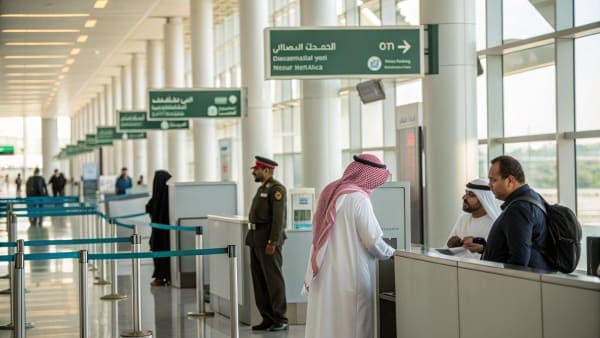
Expect passport control, a possible biometric capture and a customs check of the car. The regulation says tourist visa applicants register their biometric characteristics during the application process or upon arrival, so there is no appointment to attend before you leave the UAE, but you may be fingerprinted and photographed at the post on your first entry.
Once you are in, Article 10 of the same regulation sets out what a tourist must do: keep identification documents on you at all times, stick to the purpose the visa was granted for, and take up no paid or unpaid work. Article 11 adds that penalties apply to anyone who breaks the regulation.
Work is the one people get wrong. Visit Saudi confirms that the tourist visa does not replace the Saudi work visa, but it can be used for short business trips such as meetings, conferences and workshops that involve no contract or paid work.
Can you drive to Saudi Arabia for Umrah on a tourist visa?
Yes, outside the Hajj season. Visit Saudi's help centre states that you can use the tourist visa to perform Umrah but not during the Hajj season, and that Umrah permits are booked through the Nusuk platform. Hajj itself needs a specific Hajj visa from the Ministry of Hajj and Umrah.
The regulation backs this up. Article 10 lists not performing Hajj except under a Hajj visa and not performing Umrah during the Hajj season among a tourist's obligations, and the Ministry of Hajj and Umrah sets the dates of that season each year.
Driving in for Umrah is common, and the Ministry's FAQ confirms that a pilgrim can enter the Kingdom by one means of transport and leave by a different one. That gives you the option of driving to Makkah with the family and flying one of them home if plans change.
If you travel with family, the help centre notes that you can apply for first-degree family members, meaning spouse, parents and children, from your own account after submitting your application. VisaWadi's Saudi Arabia visa service handles the family file as one job, at AED 700 per applicant with the insurance included.
What are the rules for driving back into the UAE?
The return leg has its own checklist, and it is on the UAE side. The UAE Government portal states that visitors driving into the UAE require an international driving permit and valid vehicle insurance, that residents of GCC countries can drive in the UAE on the licence issued by the country they reside in, and that all visitors must have the correct exit permit from the country of origin and a UAE entry permit or visa.
As a UAE resident you re-enter on your residence visa, not a visitor permit, but the vehicle rules still apply: keep the IDP, the Mulkiya and the insurance in the glovebox for the trip home. The same page notes that some entry points are reserved for GCC citizens, which is one more reason to stay on the main Al Batha to Al Ghuwaifat route in both directions.
One thing you do not need is a return flight. The Ministry of Tourism regulation's return-ticket requirement applies to embassy applicants and excludes those arriving by land or sea. If you decide to fly one leg instead, a flight reservation with a real PNR from Dummy Ticket 365 covers proof of onward travel where an airline asks for it, priced from USD 13.
Why do Saudi eVisa applications and border crossings go wrong?
Most problems are avoidable and come from the documents, not the traveller. These are the ones we see:
- Residence permit about to expire. Visit Saudi requires at least three months of validity beyond your entry date. Renew the permit before you apply, not after.
- Passport under six months. The same page and Article 5 of the regulation both set a six-month minimum. A passport with five months left is refused.
- Applying as a GCC citizen when you are a resident, or the reverse. Citizens need no visa; residents need the eVisa. Getting the category wrong wastes the fee and the trip.
- Children without a parent's eVisa. Visit Saudi says a parent must apply first for any traveller under 18.
- No International Driving Permit. u.ae says residents must apply for one in the UAE before driving abroad. Arriving at the border without it invites a refusal or a roadside fine.
- Car not in your name and no letter. Bring the owner's or finance company's no-objection letter, and the vehicle entry permit the Ministry of Hajj and Umrah describes.
- Overstaying across multiple trips. The regulation caps the stay at three months within the visa year, and penalties apply.
What does the trip cost in visa and border fees?
| Item | Cost | Notes |
|---|---|---|
| VisaWadi Saudi tourist eVisa service | AED 700 all inclusive | Includes the Saudi government fee and the mandatory medical insurance. Refunded in full if the visa is refused. Saudi Arabia visa assistance. |
| Saudi government visa fee | Included in the AED 700 | Nothing further to pay to the Saudi portal. |
| Mandatory medical insurance | Included in the AED 700 | Visit Saudi confirms it is obtained as part of the tourist visa application. |
| Embassy or visa centre fees | None | The eVisa needs no embassy visit, appointment or visa centre. |
| International Driving Permit | Set by the issuing body in the UAE | Apply in the UAE before you leave (u.ae). Valid one year. |
| Motor insurance extension for Saudi Arabia | Set by your insurer | Ask before you travel. Not part of the visa. |
| Optional travel insurance for the trip | From AED 30 | AXA-issued cover through Travl if you want medical and trip cover beyond the visa's policy. |
Embassy and visa-centre fees are separate from VisaWadi's service on every other destination, and passed through at cost. Saudi Arabia is the exception: there is no such fee to pass through, so AED 700 is the whole visa bill.
Sources
- Visit Saudi (Saudi Tourism Authority): Visa regulations
- Visit Saudi (Saudi Tourism Authority): Help centre
- Ministry of Tourism, Saudi Arabia: Tourist Visa Regulations (PDF)
- Ministry of Hajj and Umrah, Saudi Arabia: FAQ
- Saudi Press Agency (official state news agency): General Directorate of Passports at Al Batha border crossing
- UAE Government portal (u.ae): Modes of travel
- UAE Government portal (u.ae): Driving abroad
- UAE Government portal (u.ae): How to get to the UAE
Planning the drive to Saudi Arabia?
VisaWadi files your Saudi tourist eVisa for AED 700 all inclusive, with the government fee and medical insurance covered and a full refund if it is refused. No embassy, no appointment, no biometrics booking. Get a free consultation on your Saudi Arabia eVisa and have the visa on your phone before you reach Al Batha.
Frequently Asked Questions
Written by

Ammar Afridi
Co-founder, Marketing Manager and Visa Consultant
Ammar Afridi co-founded VisaWadi, a Dubai-based team that prepares visa applications for UAE residents. He has spent four years working on Schengen, UK, US and Canada files, and has handled more than 2,000 applications.
Visa assistance
From AED 299
Every document checked against current embassy requirements before you submit.
Get free consultation